Introducing IMPACT: Why Does This PR Actually Affect?
I'm a software developer based in the United Arab Emirates 🇦🇪. I enjoy coding open-source projects that solve unique, out-of-the-box problems. I love combining my hobbies like design, coding and building various cool projects with Raspberry Pi and IoT. Obsessed with Automation and Software Development.
Did you ever look at a one-line code change and thought, okay, but what else could this break?
That question led me to build IMPACT, a Python PR review tool for Graph Hacks by WeMakeDevs and FalkorDB. 🚀
A diff shows what changed. It doesn't always show the functions that call that code, or which tests might be affected. IMPACT maps these relations in FalkorDB, then follows them to produce a graph you can inspect.
Testing the idea
I started with a small checkout repo instead of a huge project. It has pricing, cart, checkout, receipts, and a few tests—enough for one change to travel through different files.
Then I broke the coupon calculation on purpose:
# Before
discount_cents = min(subtotal_cents, coupon_cents)

# After
discount_cents = coupon_cents
A $30 coupon on a $20 cart now gives a negative total. The receipt test expects 0 but gets -1000. The checkout test raises an error because it refuses to charge a negative amount. The normal-coupon test still passes.
I wanted IMPACT to find those tests from the code relationships, and to show me why it picked them.
Following the calls
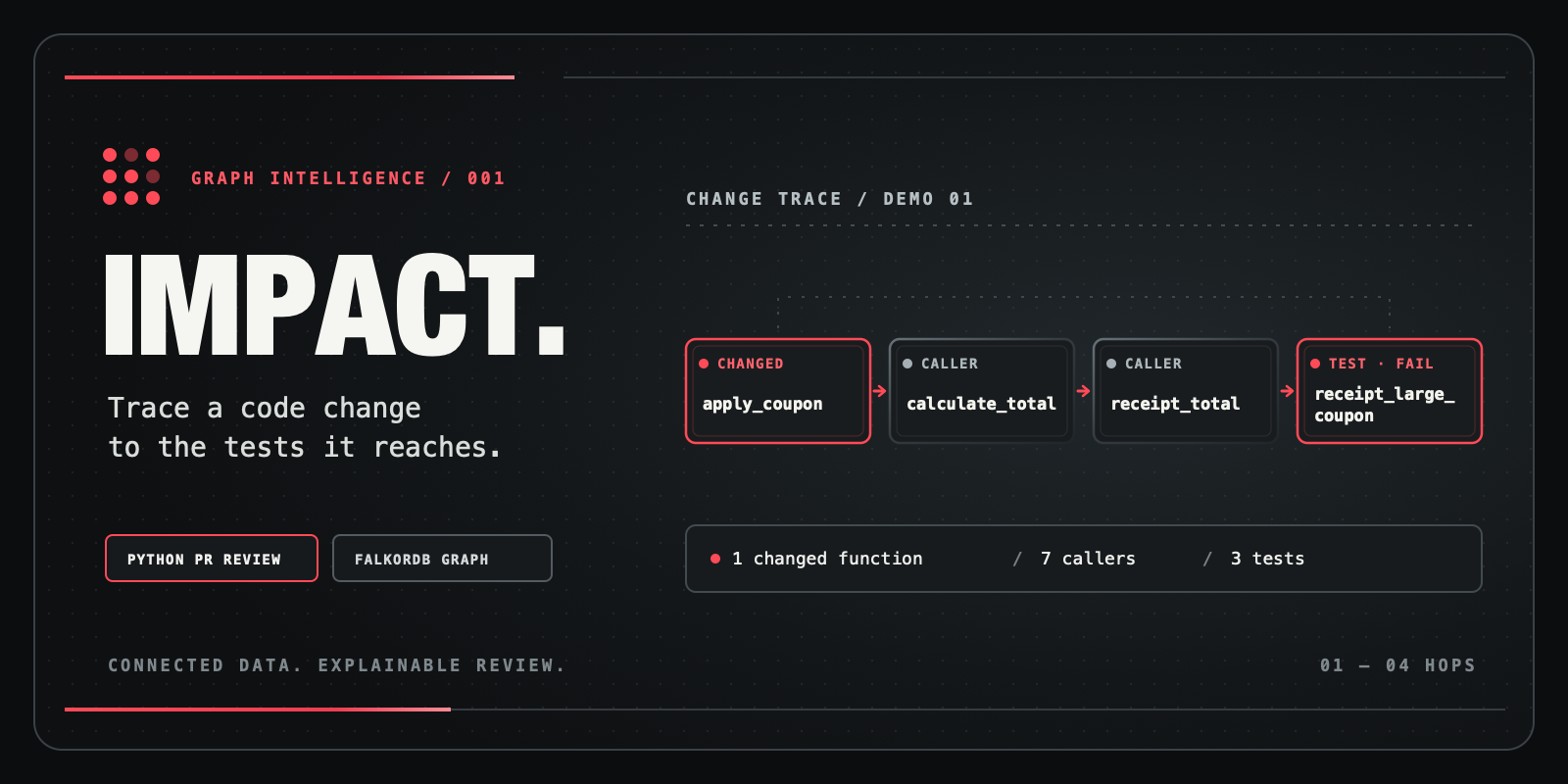
IMPACT stores files and functions in FalkorDB, with a CALLS connection whenever one function calls another. In the demo, checkout eventually reaches the changed apply_coupon function through cart and pricing code.
When apply_coupon changes, IMPACT walks those connections backwards. It finds seven reachable callers, including three tests. One of the test paths is four calls long—something I wouldn't get from looking at the diff alone.
This is the Cypher query behind it:
MATCH p = (caller:Function)-[:CALLS*1..4]->(changed:Function {id: $id})
RETURN caller.id, caller.is_test, length(p), [n IN nodes(p) | n.id]
The HTML report uses those same paths. Click a test, and you can follow its connection back to the changed code.
Getting there took a few tries. I got stuck connecting to FalkorDB at first, and later had to fix a shortest-path query to use the syntax FalkorDB accepts. The doctor command now checks the connection and graph queries before I run a review.
Who should review the change?
I added another question to the demo: who knows this part of the code, and why was it written this way?
For that, I made a small, fictional company dataset. It links a code file to its owner, her team, and three source records: a decision about coupon limits, a support ticket about negative charges, and a team chat. IMPACT puts those links in FalkorDB alongside the call graph. Ask it about apply_coupon, and it suggests Maya Chen as a reviewer and points to the records behind that suggestion.
You can see the same context in the HTML report next to the test paths. It's a demo of the idea, with synthetic people and documents; it doesn't connect to a real company's Slack or ticket system yet.
The AI part
At first, I thought an AI agent for this hackathon might have to be a chatbot. For IMPACT, the useful action turned out to be choosing what to inspect and which test to prioritize.
The AI step is optional. The model calls a FalkorDB tool, looks at the affected code, and picks a test to inspect first. IMPACT checks that the choice is actually connected to the change. Then the test runner supplies the real pass, fail, or error result.
If I leave out the AI API key, the graph analysis and test selection still work.
What I'd improve next
IMPACT can also take a public GitHub PR URL and generate a Markdown review. It has an option to post that review as a PR comment.
The parser is still static Python analysis. Dynamic calls and runtime imports may be missed, so a call path means possible impact. I want to try it on more repositories and see where it needs to improve.
I'm entering with IMPACT in Track 01: Agents That Act on Connected Data and Track 03: Company Brain. The first follows the code graph to help review a change; the second adds the people and decisions connected to that code.
If you review Python PRs, would seeing both the path to a suggested test and the reason behind a past decision help you? 🤔
🎥 Demo: https://cap.so/s/ayymw5gzz6qw9ds 💻 Source code: https://github.com/Omar8345/IMPACT